Go Language Introduction
What is Go?
Go (also known as Golang) is a statically strongly typed, compiled, concurrent programming language with garbage collection, developed by Google. Go language design began in 2007, was officially released to the public in November 2009, and the first official version Go 1.0 was released in March 2012.
The original design intention of Go was to solve problems encountered in large-scale software development within Google, particularly:
- Slow compilation speed
- Complex dependency management
- Difficult concurrent programming
- Poor code readability
Key Features
1. Concise Syntax
Go language has very concise syntax with only 25 keywords. Compared to other languages:
| Language | Number of Keywords |
|---|---|
| Go | 25 |
| C | 32 |
| C++ | 63 |
| Java | 50 |
| Python | 35 |
The concise syntax makes Go easy to learn and use, with unified code style and strong readability.
2. Fast Compilation
Go language compiles very quickly, thanks to:
- Dependency analysis optimization
- Modular compilation
- Efficient compiler implementation
Large projects can typically complete compilation in seconds to tens of seconds.
3. Native Concurrency
Go language supports concurrency at the language level, providing two concurrency primitives:
- Goroutine: Lightweight thread with initial stack of only 2KB, dynamically growable
- Channel: Used for communication between Goroutines
// Start a goroutine
go func() {
    fmt.Println("Hello from goroutine")
}()

// Use channel for communication
ch := make(chan int)
go func() {
    ch <- 42
}()
value := <-ch
4. Memory Safety
- Automatic garbage collection (GC)
- Strong type system
- Memory safety guarantees, no pointer arithmetic
5. Rich Standard Library
Go language provides a rich standard library covering:
- Network (HTTP, RPC, WebSocket)
- Cryptography (AES, RSA, SHA)
- File processing
- JSON/XML parsing
- Testing framework
- And more
6. Cross-compilation
Go supports cross-compilation, allowing you to compile executables for another platform on one platform:
# Compile Windows executable on Linux
GOOS=windows GOARCH=amd64 go build -o app.exe
Application Areas
Go language is widely used in the following areas:
Cloud Native and Infrastructure
- Docker: Container technology
- Kubernetes: Container orchestration platform
- Prometheus: Monitoring system
- etcd: Distributed key-value storage
Network Services
- Microservice architecture
- API gateway
- Load balancer
- RPC framework
Blockchain
- Ethereum: Ethereum client Geth
- Hyperledger Fabric
- Various public chain projects
Command Line Tools
- Terraform: Infrastructure as code
- Consul: Service discovery
- Vault: Key management
- Helm: Kubernetes package management
Databases
- TiDB: Distributed database
- CockroachDB: Distributed SQL database
- InfluxDB: Time-series database
Comparison with Other Languages
| Feature | Go | Java | Python | C++ |
|---|---|---|---|---|
| Compilation Speed | Fast | Medium | No compilation | Slow |
| Execution Performance | High | Medium | Low | High |
| Concurrency Support | Native | Thread library | Thread library/async | Thread library |
| Learning Curve | Gentle | Medium | Gentle | Steep |
| Memory Management | GC | GC | GC | Manual |
| Deployment Method | Single file | JVM | Interpreter | Single file |
Design Philosophy
Go language's design philosophy can be summarized as:
Less is more
Specifically embodied in:
- One way to do things: Does not provide multiple ways to implement the same function
- Explicit is better than implicit: Code behavior is clearly visible
- Composition over inheritance: Use interfaces and composition, not inheritance
- Simple is better than complex: Keep the language and libraries simple
Go Language Mascot
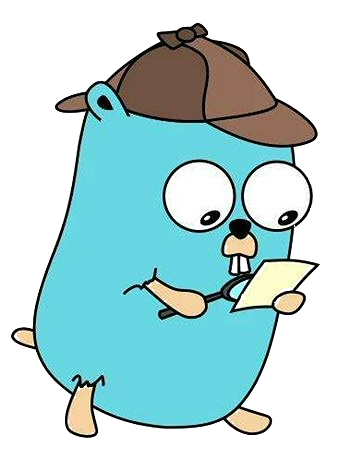
The mascot of Go language is a blue gopher designed by Renee French. This cute Gopher has become an iconic symbol of the Go community.

Next Steps
- Quick Start - Start your Go journey
- Download and Install - Download and install Go
- Installation Guide - Detailed installation instructions